Saturday, 21 February 2009

Children with Chrons Disease & Folic Acid Link

Chemical Structure of Folic AcidIt has been found that Children with inflammatory bowel disease (IBD), that includes children with chrons and ulcerative colitis have low levels of Folic Acid in their blood, this ads to the theory that people with chrons and ulcerative colitis are lacking in Folate (Folic Acid)


What is Folic Acid?
Folic acid which is also called Folate, Vitamin B9 or Folacin are the types of the water-soluble Vitamin B9. The names of Folate and Folic acid come from the Latin word folium which means leaf.

Why is Folic Acid important?
Vitamin B9 that is essential to numerous bodily functions. It is vitally important during periods of rapid cell division and growth, this includes childhood and when a person is pregnant. Both children and adults require folic acid to produce healthy red blood cells and prevent anemia.

Researchers from the University of California in San Francisco believe that IBD in children may be different from the IBD that affects adults. This discovery was made when they measured blood folate levels in 78 children, nearly half of whom had recently been diagnosed with IBD while the remainder were healthy controls. Folate levels were nearly 20 per cent higher in the IBD group, the researchers found, even though the controls were ingesting around 18 per cent more folate from their diet.

Folic Acid in Foods
Folate is found in leafy vegetables, so things like spinach, turnip greens, lettuces, dried beans and peas, fortified cereal products, sunflower seeds and certain other fruits and vegetables are rich sources of folate. Liver and liver products also contain high amounts of folate, as does baker's yeast. Some breakfast cereals (ready-to-eat and others) are fortified with 25% to 100% of the recommended dietary allowance (RDA) for folic acid.

Folic acid is added to grain products in many countries, and in these countries fortified products make up a significant source of folate.

Sources: American Journal of Clinical Nutrition, 2009; 89: 545-50 & Wikipedia.

Sunday, 4 January 2009

Can Digestive Advantage help Chrons & Colitis?

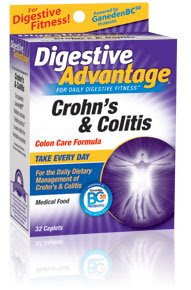
Digestive Advantage Chrons & Colitis?Today I read about an over the counter drug that has been approved by the Food and Drug Administration (FDA), that is supposed to help people with conditions including Irritable Bowel Syndrome, Chrons disease and colitis.

The drug known as Digestive Advantage™ Crohn's & Colitis Therapy mostly contains a patented probiotic called GanedenBC30 that is said to help the functioning of the digestive system. The specially isolated cultures are protected by a hardened layer of organic material that enables them to go through your acidic stomach environment and successfully arrive to your intestines, which is where they can have the most benefit.

I wonder how well these are going to help people with chrons disease, what I do know is that it won't be a miracle cure as the do say in the small print that "Digestive Advantage™ Crohn’s & Colitis Therapy is a Medical Food product that is intended for use by Crohn’s & colitis sufferers who are under the supervision of a physician. It is not a cure for Chrons or ulcerative colitis nor is it intended to replace any medications that were prescribed by a physician"

What ever the case, at the moment I think that it is only available in the US at a cost of about 55c per day, it could be worth speaking to your doctor about.

If anyone has tried them or knows any thing more I would love to get your feedback.

You can find more information on their website: Digestive Advantage™ Crohn’s & Colitis

Monday, 15 December 2008

Children with Chrons Disease Helped with Growth Hormone

Kids with Chrons disease can experience stunted growth, which at this very important period of their lives can have huge implications. Now according to a US report, it may be possible that some shots with a growth hormone may help children with Chrons disease with a growth spurt as well as improve bone mineralisation and body composition.

Encouraging Results
For the duration of 1 year at the University of California San Francisco, Dr. Melvin B. Heyman and his and colleagues treated 10 Children with Chrons Disease all aged between 4 and 19 years old with daily shots of the growth hormone. In this small study, there were shown to be healthy gains in bone mineralization at the lumbar spine as well as the average percent of body fat decrease in the children, this would indicate an increase in lean body mass.

With the growth hormone, the average height of the children increased from 3.00cm per year at the outset to 8.32cm per year after the 1 year of treatment, which is a real significant increase.

More Research Needed
Before these results, previous trials using growth hormone treatment on children with Crohn's disease showed mixed results, with many of them conflicting, so whilst these latest results are very promising, there is still much work and research to be done before the growth hormone can be used to treat pediatric patients with Chrons disease who also have stunted growth.

SOURCE: The Journal of Pediatrics, November 2008.

USA: Chrons Disease Books


UK: Chrons Disease Books

Tuesday, 25 November 2008

Advances in Chrons Disease Surgeries

Chrons Disease: Cut away of the Colon
This week, leading Chrons Disease experts at the York-Presbyterian Hospital, in the US have said that today people who suffer from chrons disease, the chronic inflammatory bowel condition are living longer healthier lives and this is mainly down to innovative new surgery.

There are an estimated half a million people in the USA alone who suffer from Chrons disease, which starts off inflammation along the gastrointestinal tract and is most often found in the lower bowel. Today there are certain drugs can help ease symptoms of chrons disease, but to date there is no cure for crohn's. There are often complications related to Crohn's disease and these often include fistulas which are abnormal, obstructive connections between tissues in the body, strictures which is basically the narrowing of the bowel, abscesses, perforations, haemorrhage and even cancers. Because of these complications chrons disease sufferers will often require some sort of surgery.

Dr Fabrizio Michelassi who is an author as well as a professor and chairman in the Department of Surgery at Weill Cornell Medical College he is also the surgeon in chief at New York-Presbyterian Hospital/Weill Cornell Medical Center said that out of five patients with chrons disease, four of them will need some kind of surgery during some point of their lives. The new,advanced and minimally invasive techniques however are sparing the patients precious bowel tissue and at the same time improving quality of life.

Dr. Sharon Stein who is the assistant professor of surgery at Weill Cornell Medical College and colorectal surgeon at New York-Presbyterian Hospital/Weill Cornell Medical Centre said that "In the past, this was limited to complex, invasive surgeries that required the removal of whole sections of the affected bowel. But over the past two decades, advances in surgery have changed that paradigm,"

Innovations in Chrons Disease Surgery


Fistula Plugs:

For anyone who has had a fistula, and I will know they are often painful as well as being dangerous as they can cause the contents of your intestines to diverge from the anal canal. This can often progress to anal incontinence, abscesses and in the most serious cases systemic infection. There are now certain surgical procedures that can drain the fistula tract but for more difficult lesions there is a new new surgical anal plug which is made from grafted porcine tissue and is then placed over the fistula. This fistula plug then is the catalyst for the growth of fibrotic tissue in the area that will then close off the fistula passage. According to Dr Stein, recent studies have shown this method to be successful in up to half of Chrons patients.


Laparoscopic surgery:

Another new innovation in surgery for people with Chrons disease is known as Laparoscopic surgery which are minimally invasive techniques requiring only a small incision and leaves very little external scarring. Laparoscopic surgery can take longer to perform than conventional surgery techniques, but lead to shorter stays in hospital, which not only saves money, but because chrons disease patients often spend long periods in hospitals can be very important to them.


Strictureplasty:

The technique of Strictureplasty has completely changed bowel surgery as the technique alows the surgeon to leave the disease affected length of bowel in place but widen it, it is "much like letting out the seams on a pant-leg," explains Dr Michelassi, who is a world renowned pioneer in the technique of Strictureplasty. This saves bowel tissue while "restructuring" it, so that intestinal contents can safely pass through. before Strictureplasty, surgeons would have to cut out whole sections of bowel affected with Chrons disease, shortening the organ which leads to the limiting of the gastrointestinal tract.

(Source: New advances in surgical treatment of Crohn's disease. Practical Gastroenterology: November 2008)

USA:
Books on Crohn's Disease from Amazon.com

UK:
Books on Crohn's Disease from Amazon.co.uk

Thursday, 25 September 2008

Perianal Fistulas and Chrons Disease

Many people who suffer from chrons, then often go on to get fistulas of some sort, including Perianal fistulas. So what exactly is a Fistula?

The medical definition is that a fistula is an abnormal tunnel that connect two body cavities like the rectum to the vagina or it can connect a body cavity to the skin, so the rectum to the skin.Ok, so we now know what a fistula is, so then what is a Perianal Fistula? Quite simply a Perianal fistula is a fistula that connects the perianal skin with the anus or the rectum.

How are fistulas formed?
When a abscess in your body does not heal, this the eventually breaks through the skin or into another body cavity as described before.

It has been found that fistulas are far more common in people with chrons disease than those with ulcerative colitis and it has been found that about a quarter of people with Crohn's disease go on to develop a fistula.Perianal fistulas with people who have chrons can cause scarring, faecal incontinence, and in about 10 to 18% of people even proctectomy (which is a surgical resection of the rectum. Also called rectectomy.)

The diagnostic and therapeutic options to those with perianal fistulas available were limited, but this has started to change recently over the last ten years or so and the options for the diagnosis and treatment of fistulizing Crohn's disease have changed allot and are still continuing to change and improve even though the exact way to treat them is still controversial.

Wednesday, 17 September 2008

Research may help painful Symptoms of Chrons Disease

In the USA today, there are more than half a million people with Chrons disease and if you break it down, more than 100 thousand of these are children. As we know so far there is no cure, so until we find a cure for chrons disease, the main angle of attack is to reduce the symptoms. (Crohn's disease is an inflammatory bowel disease that causes the intestinal lining to become inflamed, and this causing severe abdominal pain, diarrhea, vomiting, nausea and bleeding.)

The good news is that it now seems that some researchers may just have found a way to help reduce the painful symptoms of chrons disease.

The video below tels of Taralyn Allen, who is 15 years old who has had chrons disease for the last four years. Apparently there are still people out there who do not know that chrons can affect children, this is according to Howard Baron, M.D., a pediatric gastroenterologist at Sunrise Children's Hospital in Las Vegas. "The parents will assume it's the flu and it goes on and on and on."

Taralyn said that she felt sick all day every day and when she was correctly diagnosed with chrons, she was treated like many of us with steroids, this helped to relieve a little of the pain, but caused her to put on a lot of weight, going from 70 pounds to 130 pounds in just a few months.


She now no longer takes steroids and is the first child in the world to take part in a study of a new drug marketed at Humira (adalimumab). This drug has already shown to work with adults with chrons disease.

Humira (adalimumab) is an antibody that fights against a chemical that starts the inflammatory cascade in your body. It prevents white blood cells from migrating to the lining of tissues, which causes the inflammation and the pain.

Humira (adalimumab)does have side effects: It decreases the immune system and children with Chrons disease could be at a slightly higher risk for lymphoma.


Happily for Taralyn the Humira has worked and now for her Chrons disease does not exist anymore

Humira is still undergoing research and children as young as five can enroll in the clinical trial. The youngest patient enrolled so far is 10-years-old.

Video of Taralyn and her fight against Chrons Disease

Sunday, 14 September 2008

The Crohn's Diet, Colitis Diet and Superfoods

Can Superfoods help cure Chrons disease?
Because Chrons disease affects the digestive system and certain types of food play a role in triggering the genes that cause this inflammatory bowel disease, a team of scientists in New Zealand are focusing their research on crones disease whilst looking to see if certain foods are linked to disease prevention in general. So for example they are looking for food that is linked to disease prevention, such as broccoli and colon cancer.

The research project consists of around 700 IBD and Chrons patients, who have all begun by listing the foods that their body cannot tolerate, or that cause them to have a flare up. They then compare the genetic differences in people who have chrons disease with their tolerances and in-tolerances of foods in their diet. The researches are also collecting details on the patients lifestyle as well as their symptoms.

Initial findings have shown that foods like Bananas, starchy vegetables, ginger and couscous have been pointed out as good foods for the Crohn's and Colitis diet, where as carbonated drinks, energy drinks, alcohol, coffee, food like hot curries, salami, grapefruit, cream, fruits that have small seeds and corn have generally shown to be bad foods for the Chrons diet.

Cabbage and the Colitis Diet: Their research has shown that certain chrons disease patients who have a certain gene find that cabbage causes a flare up where as other patients who do not contain the gene not only can eat cabbage in their diet, but have found that it actually is beneficial!

Generally The Good Chrons Diet contains things like:
Bananas
Couscous
Ginger
Starchy Vegetables

Generally The Bad Crohn's Diet contains things like:
Coffee
Alcohol
Energy Drinks
Carbonated Drinks
Hot Curries
Salami
Grapefruit
Cream
Fruit with small seeds

The New Zealand scientists are basically looking for two things in the Crohn's and Colitis diet: the gene "switch" that makes people prone to inflammation and a nutrient (or food) that turns it off the inflammation.
Ultimately it is hoped that this research will go on to other inflammatory illnesses like colitis and that they will be able to find other nutrients that turn off these harmful gene "switches". They are the fist to say that there is a long way to go, but it has already been shown that in Singapore, there has been an increase in western diseases as their diet changes and becomes more westernised. (In Singapore all babies are genotyped)

It is thought that, in the developed world, Chrons disease affects one in every 10,000 people, In New Zealand research has shown that they have an even higher proportion, with one in 600 people in the Canterbury area alone. Professor Lynn Ferguson of the University’s Nutrigenomics group says that "Chrons disease is on the rise, and it is important that we learn as much as possible about how diet affects symptoms and whether this is genetically linked."